


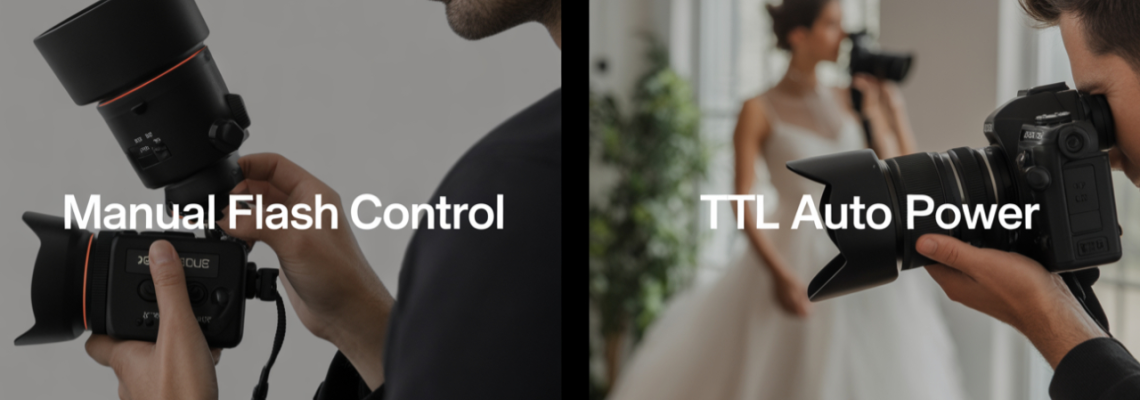
Introduction: Manual vs TTL Flash Explained
When photographers talk about mastering light, they often mention manual vs TTL flash. These two flash modes are essential tools that shape how light interacts with your subject and environment.
For beginners stepping into flash photography, this topic can seem intimidating. But once you understand it, your lighting control improves dramatically.
What Is Flash Photography?
Before diving deep into manual vs TTL flash, it’s important to understand the basics of flash photography.
Flash photography means using an artificial light source — a flash — to illuminate a subject. It helps you control exposure, reduce shadows, and bring life to dark environments.
Flash is especially useful when:
Shooting in low light
Balancing bright backgrounds
Freezing motion
Highlighting key details
As Geonline explains, flash photography isn’t just about adding light — it’s about shaping it to create mood and balance.
Understanding Manual Flash
In manual flash mode, the photographer controls everything — from flash power to exposure balance.
You set the flash output manually — for example, full power (1/1), half power (1/2), or lower like (1/4, 1/8, etc.). The flash then emits a fixed amount of light every time.
How Manual Flash Works
Manual flash doesn’t rely on your camera’s metering system. You decide how bright the flash should be based on your camera settings and scene.
For instance:
If your subject looks too bright → reduce flash power.
If it’s too dark → increase flash power.
This approach gives complete creative control, making it ideal for studio shoots, product photography, or portraits where lighting remains consistent.
Advantages of Manual Flash
Predictable Results: You decide how much light each shot gets.
Consistency: Perfect when you’re taking multiple shots in the same lighting.
Learning Opportunity: Great for mastering light control and exposure.
No Guesswork from Camera: You control the output — not the camera’s automatic system.
Disadvantages of Manual Flash
Slower Setup: Requires testing and adjusting manually.
Not Ideal for Fast-Moving Scenes: You might miss the moment while changing power levels.
Yet, as Geonline often emphasizes, learning manual flash teaches you the real language of light — making it an essential skill for serious photographers.
Understanding TTL Flash (Through-The-Lens)
TTL stands for “Through The Lens” metering. It’s a smart, automatic flash mode that uses your camera’s internal metering to decide how much light is needed.
When you press the shutter, the camera measures the light reflected through the lens, then adjusts the flash output automatically for proper exposure.
How TTL Flash Works
The flash emits a pre-flash before the main shot.
The camera measures reflected light from the pre-flash.
The system instantly calculates the correct power for the main flash.
That’s why TTL flash is perfect for dynamic environments like weddings, events, or outdoor shoots — where light constantly changes.
Advantages of TTL Flash
Automatic Exposure: The camera adjusts the light for you.
Faster Workflow: Great when you don’t have time to tweak settings.
Dynamic Adaptation: Works well in changing lighting conditions.
Beginner-Friendly: You can focus more on composition than technical details.
Disadvantages of TTL Flash
Inconsistent Results: The camera’s metering might over- or under-expose.
Less Creative Control: It decides for you, sometimes incorrectly.
Battery Drain: TTL often uses more power due to pre-flashes.
Still, as Geonline notes, TTL is a game-changer for photographers who need speed and flexibility on the go.
Manual vs TTL Flash: The Key Differences
Here’s a simple comparison table to understand how manual and TTL differ:
How to Use Camera Flash Correctly
Whether you use manual or TTL, using flash correctly makes or breaks your photo quality.
Here are Geonline’s professional tips:
Avoid Direct Flash: Always bounce or diffuse the light.
Match Flash with Ambient Light: Don’t overpower the scene; balance both.
Use Diffusers or Softboxes: These spread light softly, reducing harsh shadows.
Adjust ISO, Aperture, and Shutter: Flash exposure depends on all three.
Position Your Flash Smartly: Move it off-camera for better depth.
Balancing Flash with Ambient Light
Balancing flash and ambient light creates natural-looking photos. If you rely only on flash, your background might look too dark.
To balance both:
Lower your flash power slightly.
Increase ISO or reduce shutter speed.
Use TTL flash compensation or manual flash adjustment to fine-tune brightness.
Pro tip from Geonline: Use the flash for your subject and let the ambient light handle the background.
On-Camera vs Off-Camera Flash
On-Camera Flash: Mounted directly on the camera. Great for portability but often creates flat lighting.
Off-Camera Flash: Positioned away from the camera, offering depth, dimension, and creative control.
Modern setups allow wireless triggers, letting you use multiple flashes in a single setup — perfect for creative lighting techniques.
Bounce Flash Techniques for Soft Lighting
Bouncing flash off ceilings or walls gives a soft, natural look.
Aim the flash upward instead of directly at the subject.
Use a white ceiling or reflector to diffuse light evenly.
Avoid colored walls — they can tint your photo.
Geonline’s advice: Bounce flash is your best friend for indoor portraits. It mimics window light beautifully.
Understanding Flash Exposure Settings
Your flash exposure depends on:
Aperture: Controls how much light enters the lens.
ISO: Adjusts the camera’s sensitivity to light.
Shutter Speed: Determines how much ambient light appears.
In manual mode, you’ll adjust all three to achieve perfect exposure.
In TTL mode, your camera helps balance them automatically.
Using Flash Indoors and Outdoors
Indoors: Bounce the flash off ceilings or use softboxes. Avoid harsh direct lighting.
Outdoors: Use flash to fill shadows on bright sunny days. Balance flash with daylight for a natural look.
A little flash outdoors can add sparkle to eyes and restore contrast — a secret many pros use quietly.
Common Mistakes in Flash Photography
Using direct flash without diffusion
Ignoring ambient light
Shooting at wrong sync speeds
Forgetting flash distance
Not checking white balance
Each of these mistakes can ruin even a great shot — but understanding manual vs TTL flash helps fix them quickly.
People Also Ask (FAQ Section)
1. What is the difference between manual and TTL flash?
Manual flash gives full control to the photographer, while TTL flash adjusts automatically using camera metering.
2. Is TTL flash better for beginners?
Yes. TTL flash simplifies exposure, making it ideal for new photographers learning to balance light.
3. When should I use manual flash?
Use manual flash when lighting conditions are stable — like in studios or controlled environments.
4. Can I mix manual and TTL flash together?
Absolutely. Many professionals mix them — using TTL for main light and manual for fill or background lights.
5. Why does my TTL flash overexpose sometimes?
It happens when your camera’s metering misreads reflective surfaces. Adjust flash exposure compensation to fix it.
6. How can I avoid harsh shadows with flash?
Use diffusers, softboxes, or bounce flash to spread the light evenly and soften shadows.
7. What’s the best flash mode for portraits?
Both work — manual for precision, TTL for dynamic shooting. Experiment and find your balance.
Final Thoughts
Learning the difference between manual vs TTL flash transforms how you use light. Manual flash teaches discipline, while TTL offers flexibility.
Leave a Comment